
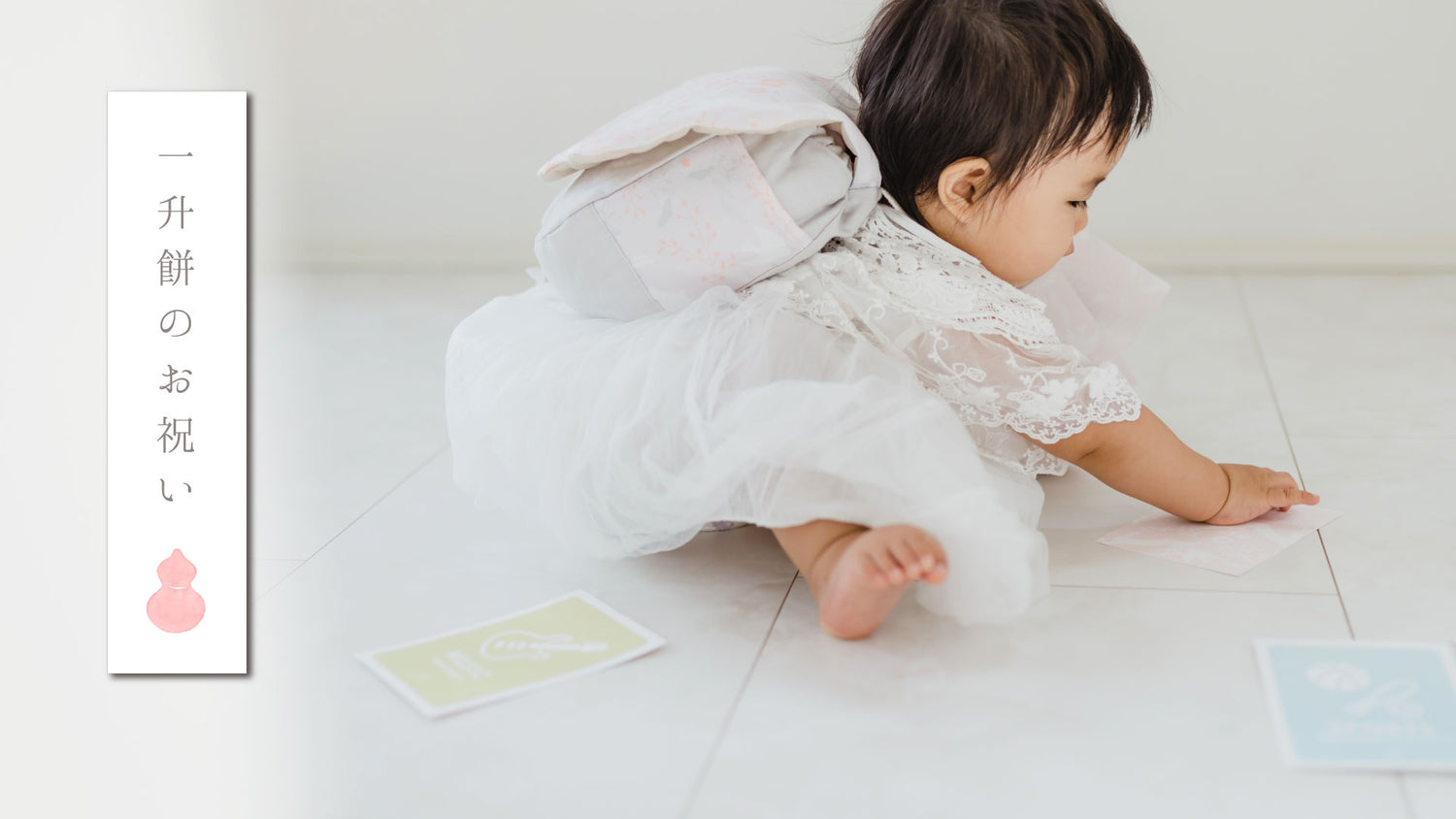
What is the Issho-Mochi Celebration?
< A traditional event to wish for healthy growth and a fulfilling life >
The Issho-Mochi celebration is a traditional event held alongside a child's first birthday to pray for their healthy growth in the future.
It involves a rice cake made from one *issho* (approx. 1.8 kg) of glutinous rice, weighing around 2 kg. The baby carries this rice cake on their back, but it can be so heavy that they cry or are unable to carry it. Children around one year old show varying rates of development, so some may not be able to carry it or even stand. Regardless of these challenges, the very act of performing the Issho-Mochi ceremony itself is a joyous celebration.


-

1. Origin and History of Issho-Mochi Celebrations
The Issho-Mochi celebration is a traditional event that has been passed down for a long time, but there is no record of when it began. However, the custom of Issho-Mochi is transmitted throughout various regions of Japan and is considered a rite of passage used to celebrate a child's first birthday.
Mochi has long been an important food used to celebrate special occasions (hare no hi) such as childbirth, births, festivals, and seasonal festivals. Among these, it is said that the sun goddess Amaterasu Omikami resides in Issho-Mochi (kagami mochi), and the mochi itself is likened to Amano-Iwato, where Amaterasu Omikami hid. Therefore, the Issho-Mochi used in celebrations is believed to bring good harvests and future harmony, and "kagami biraki" (mirror breaking ceremony) is performed as if Amano-Iwato has opened, with the mochi then cut and eaten. When kagami mochi naturally cracks due to drying, it is also referred to as "opening," and this is believed to be a blessing from Amaterasu Omikami, making it an auspicious item.
Furthermore, the word "issho" (one sho) also carries the meaning of "a lifetime" (isshou). When combined with the auspicious mochi, it expresses wishes such as "may you never be in want of food your whole life" and "may you be healthy your whole life." The round, flat shape also conveys the meaning of "may you live a harmonious life forever."
Issho-Mochi events vary slightly depending on the region and household, and as they are passed down from parent to child, they are celebrations that reflect the unique characteristics of each family. Although it has become common today, some regions also perform "erabitori" (choosing ceremony) along with Issho-Mochi.
The name also differs in various regions, and it is also called "Issho Mochi," "Tanjo Mochi," "Issai Mochi," and "Chikara Mochi."

-

2. How to Perform the Issho-Mochi Ceremony
Even among one-year-olds, there are individual differences. Some children cannot stand, while others can stand while carrying the mochi, and some start walking early. Regardless of whether the child can stand or walk, the issho-mochi ceremony is considered auspicious. Depending on what happens, it is said that if the child stands, they will "establish themselves in life"; if they sit, they will "carry on the family legacy"; and if they fall, they have "warded off evil." The act of performing the issho-mochi ceremony itself is considered good luck, so simply watch over your child carefully.
◆ Mochi-Oi (Mochi Carrying) ◆
This is the generally accepted way to perform the issho-mochi ceremony. The issho-mochi is called "shoi-mochi" or "seoi-mochi" (back-carrying mochi). The child carries the issho-mochi, which has characters like "kotobuki" (felicity) or the child's name written on it, on their back. Parents then watch as the child struggles to stand or falls, with hopes and dreams for their future. In the sense of letting the child feel the "weight of a lifetime," if a child stands and walks easily, they may even be intentionally made to fall.
◆ Mochi-Fumi (Mochi Stepping) ◆
In this ceremony, the issho-mochi is likened to the earth. The child wears straw sandals and is stood on the issho-mochi, with the wish that they will "firmly plant their feet on the earth and walk through life." Some families perform both "Mochi-Oi" and "Mochi-Fumi."
◆ Special Edition: Kanreki (60th Birthday) Celebration ◆As an auspicious event, issho-mochi may also be used for celebrating long life at birthdays such as Kanreki (60th), Kakou (60th), Koki (70th), Kiju (77th), Sanju (80th), Hanju (81st), Beiju (88th), Sotsuju (90th), Kyuju (90th), Hakuju (99th), Hyakuju (100th), Chaju (108th), Chinju (110th), Koju (111st), and Dai-Kanreki (120th). In this case, red and white issho-mochi are used, decorated to celebrate the birthday, playing on the words "mochi" and "mochii" (good to have) or "nagamochi suru" (long-lasting). After the celebration, it is customary for the family to eat the mochi together to receive the blessings of long life.

-

3. Choosing an object
At a child's first birthday celebration, called "hatsu tanjo" (first birthday), many families also perform "erabitori" (choosing an object) along with "issho mochi" (one sho of mochi). In some regions, this is also called "shorai erabi" (choosing a future) and is done while the child carries the issho mochi on their back. Erabitori is a custom where objects are placed in front of the child, and the first object they pick up is used to predict their future. While the items prepared vary by family, the traditional items for erabitori are as follows. Recently, new professions and industries are actively used, so cards and other substitutes are also common.

-

In the past, a large issho mochi was the standard, but in recent years, smaller, individually packaged mochi have become popular. In addition, options such as issho-mai (a bag of rice) and issho-pan (a loaf of bread) have increased, making it easier to celebrate.
Furthermore, the furoshiki (cloth) that was used to wrap the mochi and tie it to the body has become a popular issho mochi backpack that can be used as the child grows.

Products perfect for celebrating a baby's first birthday mochi
-
![[PucaStyle] HARE RYUKKU Rabbit (with selection card♪)](//hare-kura.com/cdn/shop/files/05dd03d38923aa8785f77a4fd1f6d9f9_be8fc2fd-3c17-4751-9d5c-335bd26000b2.jpg?v=1705286478&width=533)
![[PucaStyle] HARE RYUKKU Rabbit (with selection card♪)](//hare-kura.com/cdn/shop/files/030f010b8bccf5583e25e005cf88a57e.jpg?v=1705286478&width=533)
[PucaStyle] HARE RYUKKU Rabbit (with selection card♪)
販売元:Puca StyleSale Sold outRegular price ¥7,040(税込)Regular priceUnit price per -
![[PucaStyle] HARE RYUKKU (sunny backpack) closure (with selection card♪)](//hare-kura.com/cdn/shop/files/94e700caf974bcdcc7c3dc6aa9474a03_f6e037f9-2ce3-47f7-ae7c-acf0d79a7f2f.jpg?v=1705285814&width=533)
![[PucaStyle] HARE RYUKKU (sunny backpack) closure (with selection card♪)](//hare-kura.com/cdn/shop/files/c2395f7db05e202875a567caac4c8e27.jpg?v=1705286066&width=533)
[PucaStyle] HARE RYUKKU (sunny backpack) closure (with selection card♪)
販売元:Puca StyleSale Sold outRegular price ¥7,040(税込)Regular priceUnit price per -
![[PucaStyle] HARE RYUKKU Fuji (with selection card♪)](//hare-kura.com/cdn/shop/files/7cf173b8e0ea52477ae89f11cbfe70e8.jpg?v=1705292848&width=533)
![[PucaStyle] HARE RYUKKU Fuji (with selection card♪)](//hare-kura.com/cdn/shop/files/33b074c66cc92f171779087a873560f6.jpg?v=1705292848&width=533)
[PucaStyle] HARE RYUKKU Fuji (with selection card♪)
販売元:Puca StyleSale Sold outRegular price ¥7,040(税込)Regular priceUnit price per -
![[PucaStyle] HARE rabbit 3-piece set](//hare-kura.com/cdn/shop/files/IMG_9452_1b0f885f-014a-44c7-8da0-734c0e8277ba.jpg?v=1706576244&width=533)
![[PucaStyle] HARE rabbit 3-piece set](//hare-kura.com/cdn/shop/files/IMG_9452_b17e02d3-7104-4956-b84e-60904b432f28.jpg?v=1706576244&width=533)
[PucaStyle] HARE rabbit 3-piece set
販売元:Puca StyleSale Sold outRegular price ¥15,510(税込)Regular priceUnit price per
![[PucaStyle] HARE RYUKKU Rabbit (with selection card♪)](http://hare-kura.com/cdn/shop/files/05dd03d38923aa8785f77a4fd1f6d9f9_be8fc2fd-3c17-4751-9d5c-335bd26000b2.jpg?v=1705286478&width=533)
![[PucaStyle] HARE RYUKKU Rabbit (with selection card♪)](http://hare-kura.com/cdn/shop/files/030f010b8bccf5583e25e005cf88a57e.jpg?v=1705286478&width=533)
![[PucaStyle] HARE RYUKKU (sunny backpack) closure (with selection card♪)](http://hare-kura.com/cdn/shop/files/94e700caf974bcdcc7c3dc6aa9474a03_f6e037f9-2ce3-47f7-ae7c-acf0d79a7f2f.jpg?v=1705285814&width=533)
![[PucaStyle] HARE RYUKKU (sunny backpack) closure (with selection card♪)](http://hare-kura.com/cdn/shop/files/c2395f7db05e202875a567caac4c8e27.jpg?v=1705286066&width=533)
![[PucaStyle] HARE RYUKKU Fuji (with selection card♪)](http://hare-kura.com/cdn/shop/files/7cf173b8e0ea52477ae89f11cbfe70e8.jpg?v=1705292848&width=533)
![[PucaStyle] HARE RYUKKU Fuji (with selection card♪)](http://hare-kura.com/cdn/shop/files/33b074c66cc92f171779087a873560f6.jpg?v=1705292848&width=533)
![[PucaStyle] HARE rabbit 3-piece set](http://hare-kura.com/cdn/shop/files/IMG_9452_1b0f885f-014a-44c7-8da0-734c0e8277ba.jpg?v=1706576244&width=533)
![[PucaStyle] HARE rabbit 3-piece set](http://hare-kura.com/cdn/shop/files/IMG_9452_b17e02d3-7104-4956-b84e-60904b432f28.jpg?v=1706576244&width=533)


A baby's first birthday is a day to express heartfelt joy and gratitude for their birth, as well as a day of new beginnings.
Let's make it a wonderful celebration, wishing them continued healthy growth.
baby celebration event

First meal

name giving ceremony

Shrine visit

Girls' Festival

Boys' Festival

Issho Mochi Celebration (Birthday)

First New Year - Hagoita -
